
2025 Annual BACP International Research Conference: Impact through collaboration
Co-hosted by the University of Manchester
Keynote Speakers
A keynote was presented by Professor Divine Charura and covered: Impact through collaboration in Trauma informed and social justice orientated research: Challenges and Opportunities in working with marginalised communities.
Another keynote was presented by Dr Kate O'Brien and covered: Stories of trauma, healing and harm in carceral settings: Reflections on research with women in prison.
Programme
Read the BACP International Research Conference 2025 programme
Abstract booklet
BACP International Research Conference abstract booklet 2025 (pdf)
Poster exhibition
BACP International Research Conference poster exhibition
On-demand
Access to the on-demand service, for three months after the event can be accessed an unlimited number of times, 24 hours a day.
The on-demand service is available from Monday 26 May 2025 until Monday 25 August 2025.
May 2024: 30th Annual International Research Conference: Enriching research, practice and policy with lived experience
Co-hosted with Birmingham Newman University
Keynote presentations
Mhairi Thurston: 'Vision for change: Improving client services within the sight loss sector through lived experience, research, dialogue and collaboration'.
Vanessa Pinfold: 'How lived experience expertise can shape mental health research: exploring concepts and practices'.
Abstract booklet
BACP research conference abstract booklet 2024 (pdf)
Poster exhibition
A showcase of recent research projects in counselling and psychotherapy. View the online poster exhibition 2024.
May 2023: 29th Annual International Research Conference: Global issues in counselling and psychotherapy research, policy and practice
Keynote presentations
Panos Vostanis, Richard Burgon, Anne Burghgraef, Sega Habtom and Luke Bramhall. 'Counselling rebuilding lives - Exploring the role of counselling and psychotherapy in supporting displaced people fleeing trauma, persecution and conflict'.
Nahid Nasrat: 'The complexity of refugee trauma - effective psychosocial interventions'.
Caroline Hickman: 'How can research into eco-anxiety and eco-emotions translate into counselling and psychotherapy practice?'
Abstract booklet
BACP research conference abstract booklet 2023 (pdf)
Poster exhibition
A showcase of recent research projects in counselling and psychotherapy. View the online poster exhibition 2023.
May 2022: 28th Annual International Research Conference: Striving for equality, diversity and inclusion in research, practice and policy
Co-hosted by Abertay University
Keynote presentations
Discussion panel facilitated by David Weaver: 'Race for the soul of the profession'.
Professor Heidi Levitt: 'Healing from sexual minority and intersectional stigma events: what therapists should know'.
Natalie Bailey, Mhairi Thurston and Kathryn Lock: 'Building an inclusive research culture - closing the EDI gaps in counselling research'.
Poster exhibition
A showcase of recent research projects in counselling and psychotherapy. View the online poster exhibition 2022.
May 2021: 27th Annual Research Conference: Promoting collaboration in research, policy and practice
Keynote presentations
Michael Barkham: 'The results of the PRaCTICED trial and implications for person-centred experiential therapy'.
Mick Cooper: 'The results of the ETHOS trial for young people and implications for person-centred therapy'.
Poster exhibition
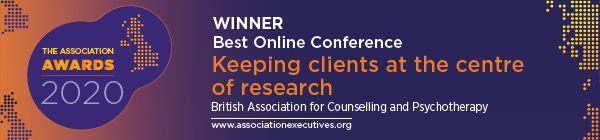
May 2020: 26th Annual Research Conference: Keeping clients at the centre of research
The online event won the Association Awards UK 2020 Best Online Conference award.
Keynote presentation
Nick Midgley, Associate Professor, University College London and co-director of ChAPTRe: 'What can therapists learn from an RCT?'.
Programme and abstract booklet
Research online 2020 programme (pdf)
BACP research conference online abstract booklet 2020 (pdf 0.3MB)
Poster exhibition
A showcase of recent research projects in counselling and psychotherapy. View the online poster exhibition 2020
May 2019: 25th Annual Research Conference: Shaping counselling practice and policy: the next 25 years
Co-hosted by Ulster University and Queen's University Belfast.
Keynote presentations
Kim de Jong, Assistant Professor of Clinical Psychology at Leiden University: 'Using routine outcome monitoring as a feedback intervention to enhance outcomes in routine practice'.
Ciaran Mulholland, Consultant Psychiatrist with the Northern Health and Social Care Trust in Northern Ireland: 'The Northern Ireland Regional Trauma Network: Treating the aftermath of psychological trauma with evidence-based therapies'.
Abstracts and presenter contact details
May 2018: 24th Annual Research Conference: Counselling changes lives: research that impacts practice
Co-hosted by the University of Roehampton
Keynote presentations
Professor Robert Elliott: 'Evidence and politics in the humanistic-experiential psychotherapies: a love-hate story'.
Professor Dr Pim Cuijpers: 'Four decades of outcome research on psychotherapies for depression: an overview of meta-analyses'.
May 2017: 23rd Annual Research Conference
Co-hosted by the University of Chester
Keynote presentations
Professor Clara E Hill: 'Therapist self-disclosure and immediacy'
Professor Stephen Joseph: 'Are we measuring what matters in counselling and psychotherapy research?'.