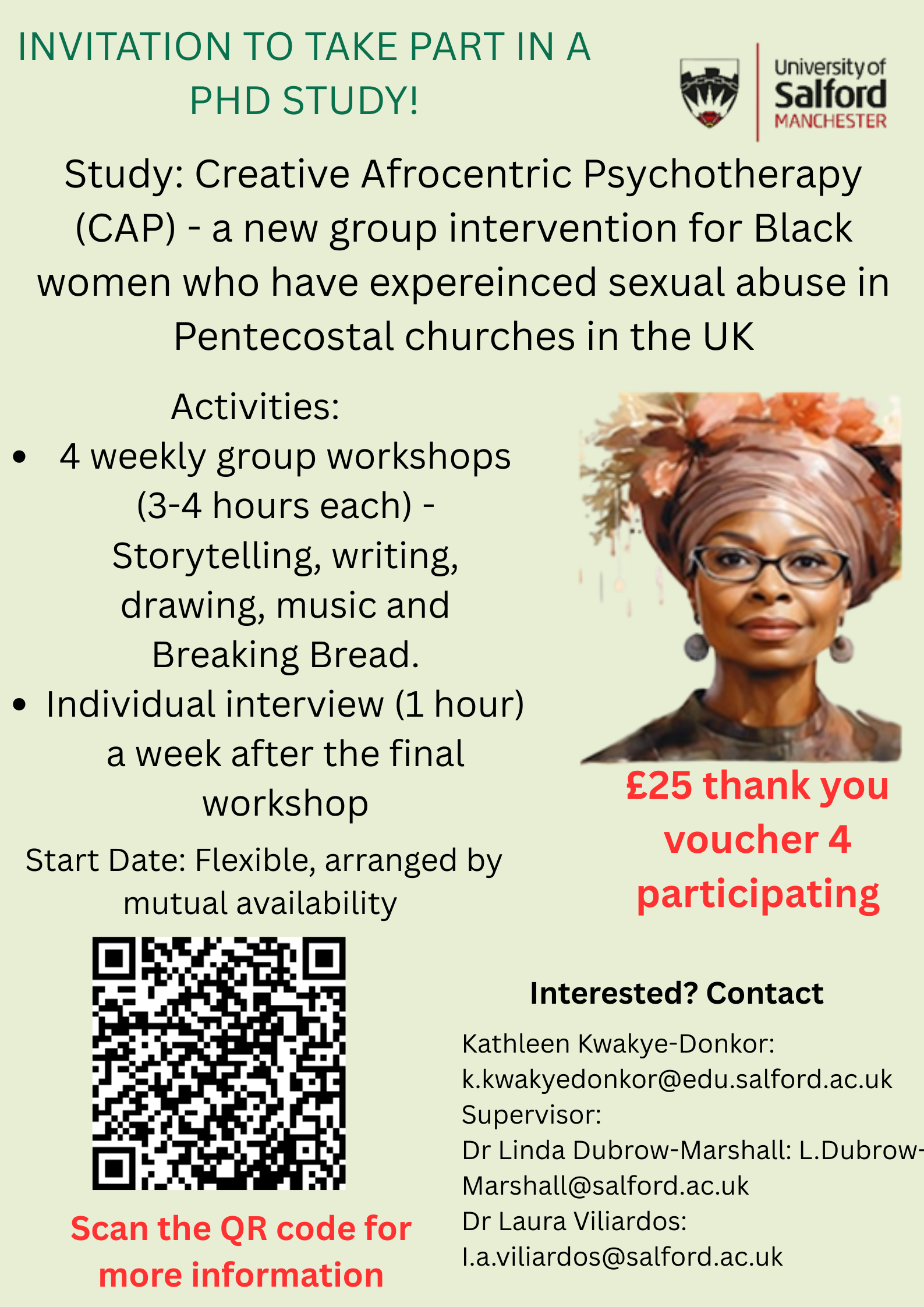
Exploring the Narratives of Creative Afrocentric Psychotherapy (CAP) for Black Women who have experienced sexual abuse in Pentecostal churches (PC) in the United Kingdom
Black women are more likely to struggle with mental health issues in the UK than white women. One issue that can contribute to poor mental health is sexual abuse. Sexual abuse can happen in spaces where people go to feel safe spiritually, that is, the church. Many counselling and psychotherapy trainings are based on Western and European models of illness and healing. The Western and European approach to psychotherapy is more structured, individualistic and pragmatic, and many black clients are not used to it.
In contrast, many black people deem storytelling as a therapeutic relationship and believe in collectivism and spirituality. Living togetherness relates to Ubuntu's philosophy: "I am because we are. There is a lack of research on Black women who have experienced sexual abuse in the Pentecostal Church. Many Black women will continue to stay in the church for decades, even after experiencing abuse, and still not report or seek help due to fear or shame (Kanyeredzi & Wilson, 2023).
People within PC lack access to mental health services (Jackson, 2017). Unfortunately, many Black Pentecostal preachers describe mental health treatment as a form of weakness, for example, 'Saints Don't Cry' (Payne, 2008).
This study aims to address this gap and will use a narrative mixed-method research (MMR) approach to explore the Narratives of CAP for Black women who have experienced sexual abuse within the PC.
The objectivist (quantitative) approach will build on the Warwick-Edinburgh Well-Being Scale, which will reveal the organismic element of participants' experience. The subjectivism (qualitative) of the ontological phenomenon will be embodied in the narratives of the participants after the workshop.
Another objective is to improve service provision, modify policies and procedures in practice regarding training therapeutic practitioners, and increase practitioners' awareness of how Creative Afrocentric approaches can benefit the Black community and the counselling profession.
The workshop will consist of four sections, covering the eight key elements of the new model of Creative Afrocentric Psychotherapy.
Each session will involve different activities for 3-4 hours.
- Week one will cover the first two elements of the new model of Creative Afrocentric Psychotherapy: Discovering Wholeness & Belongingness.
- Week two will cover the third and fourth key elements of Creative Afrocentric Psychotherapy: Breathing into Life (spiritual embodiment) & A Letter to God (Onyakopon).
- Week three will cover the fifth and sixth sessions of Creative Afrocentric Psychotherapy: Dance to the Beat & Breaking Bread.
- The final week will cover the last two elements of Creative Afrocentric Psychotherapy: Step-by-step and Goodbye & Not Forgotten.
Some traditional meals will be served at the end of each session as part of the 'Breaking Bread' experience to help bond the group. At the end of the workshop, I would invite participants to an individual, face-to-face narrative interview the following week, lasting around an hour. The narrative interview would allow participants to express deeper feelings about their experiences after the workshop.
All information from the narrative interview will remain anonymous in the analysis. The findings will fill gaps in understanding regarding storytelling, collectivism, and spirituality within the Afrocentric worldview in counselling and psychotherapy.
Additionally, the new model of Creative Afrocentric Psychotherapy CAP will support both counsellors and clients in the therapeutic relationship.
Please see here for more information on the research.
Please see here for the link to the participant information sheet.
Thank you.