
This research will explore whether shared ethnicity between client and therapist matters in the therapeutic relationship. It aims to understand if having a therapist from a similar ethnic background helps to build trust, understanding, and connection and can this affect the outcome of therapy.
My research will be focusing on counsellors and clients that identify as global majority. There are ongoing important discussions about the role of culture and identity in counselling. Some believe shared ethnicity can help clients to feel more understood, while others suggest that a therapist’s skills and cultural awareness are more important.
Participants will be selected from the global majority, as the focus of this study is to explore the lived experiences of global majority counsellors and clients. Therefore, individuals who do not meet this criterion will not be included, as their experiences fall outside the scope of the research aims.
This research aims to explore these perspectives through counsellor’s experiences. A qualitative research method will be used to gain in-depth insight. This will help explore individuals and social experiences within their natural settings, focusing on people’s stories, and will attempt to make sense of events and experiences based on the meanings they attach to them.
The main research question is: To what extent, if at all, does shared ethnicity between therapist impact the therapeutic relationship?
My two sub themes are, what challenges do counsellors experience when working with clients from different ethnic backgrounds, if any. And in what way do counsellors believe shared ethnicity effects trust, rapport, and the therapeutic relationship. 10 Additional questions will explore how counsellors think shared ethnicity effects trust, communication, and the overall relationship.
The findings from this research may help improve understanding of the role ethnicity plays in therapy. It could highlight whether shared ethnicity is important or whether other factors such as empathy and cultural awareness are more significant. This research may also help clients make more informed choices when selecting a therapist and contribute to wider discussions about diversity and inclusion in counselling.
The intention of this research is to inform my own practice by exploring the extent to which shared ethnicity influences the therapeutic relationship.
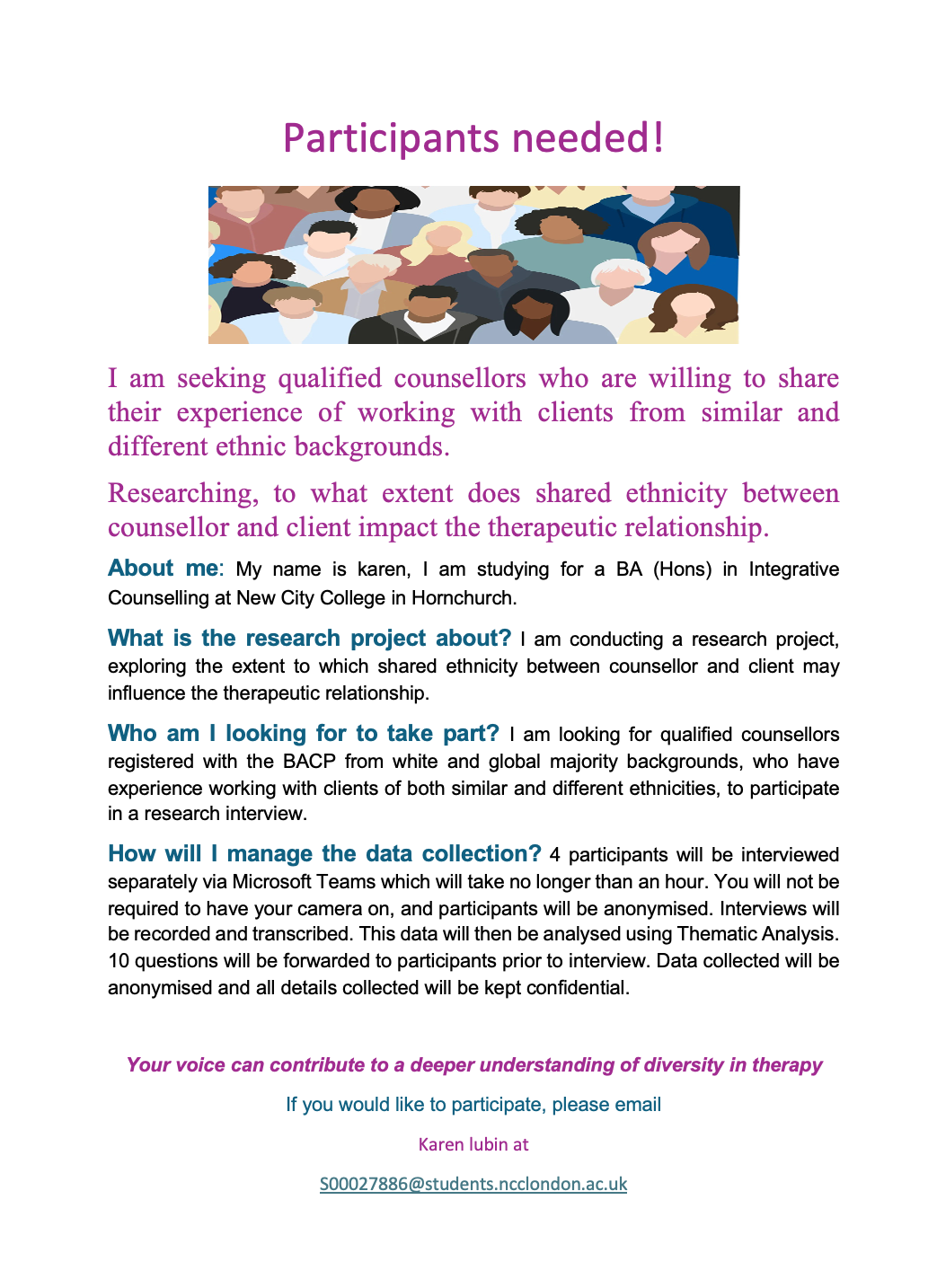
Participants will be recruited through professional platforms such as the British Association for Counselling Professionals. Along with counselling related Facebook groups. The study will be conducted in accordance with the BACP Ethical Guidelines for Research in the Counselling Profession. The research will ensure full adherence to the General Data Protection Regulations requirements. Maintaining participants confidentiality, autonomy, and the secure handling of participants data. Prospective participants will be sent a participant information sheet (Appendix B) via email, along with signposting information.
If they choose to proceed a consent form will then be provided. Interview times will be arranged through email correspondence with each participant.
Please see here for more information.
All communication will be conducted exclusively via my private student email address S00027886@students.ncclondon.ac.uk