
Continuing professional development (CPD) is a value of the Ethical Framework. All registered members must agree to reflect, plan, record and review their CPD in a structured way.
You're required to identify your learning needs and any areas of your practice that would benefit from further development. This contributes to client safety.
The Register defines CPD as:
"Any learning experience that can be used for the systematic maintenance, improvement and broadening of competence, knowledge and skills to ensure that the practitioner has the capacity to practice safely, effectively and legally within their evolving scope of practice. It may include both personal and professional development."
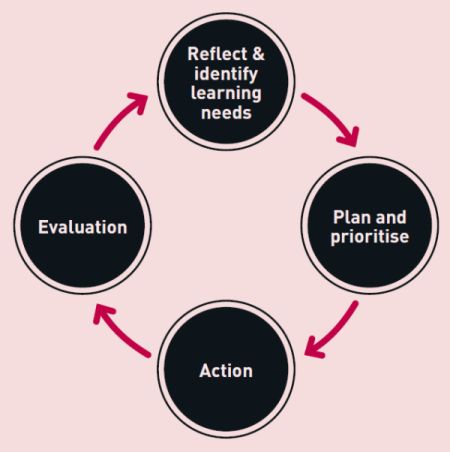
We see CPD as a cyclical process (see diagram). This will usually begin with reflection on your development needs. Sometimes learning can occur unexpectedly and this can also be recorded as CPD.
As a registered member, you must:
- keep an up-to-date and accurate record of your CPD activities in the CPD Hub or by using the Registered member record of CPD, supervision and indemnity insurance form
- record a range of CPD activities relevant to your practice
- show clearly how you've reflected, planned, actioned and evaluated your development needs and indicate how this will have an impact on your practice
- submit your record if you're selected for audit
When you join the Register, and when you renew your membership, we'll ask you to confirm that you undertake and record your continuing professional development (CPD). The specific requirements are included in our Register terms and conditions.
How do I identify my CPD needs?
You should think about any gaps in your knowledge or additional skills that will help improve your practice. You can also discuss your CPD in supervision. If you have appraisals, these can also be a useful time to discuss your CPD needs.
How much CPD should I do?
The focus should be on outcomes, or what you've gained from your CPD. However, we'd normally expect registered members to undertake at least 30 hours of CPD a year.
What counts as CPD?
Any activities that have an impact on your current or future professional practice can be included. These could include:
- conferences: attending or giving presentations
- e-learning CPD modules
- formal education, lectures, seminars, courses
- in-service training
- mentoring
- peer support groups
- organising specialist groups
- reading books, journals or internet articles
- supervising research
- TV, radio programmes and podcasts
- workshops
- work shadowing
- writing articles or papers
- self-care activities
(Supervision is a separate Register requirement and shouldn't be submitted as CPD).
You should include a mixture of learning activities in your record, although you can focus on a specific type of activity if that's most appropriate for you.
How should I record CPD?
You can plan and record your CPD in the My CPD area of the CPD Hub. For further information see My CPD plan and log tool help and support.
Alternatively, you can use the Registered member record of CPD, supervision and indemnity insurance form.
Please don't include personal, confidential or identifiable information in your record, unless this is requested for the audit.
This sample Registered member record shows how you might complete the form.
Register audit
If you're selected for the Register audit, you'll be asked to provide your Registered Member Record of CPD, supervision and indemnity insurance.
If you’ve recorded your CPD in the CPD Hub, you can submit your record for review.
If you have any questions about CPD or audit, please email us at audit@bacp.co.uk
Useful links

Register requirements for audit
Every month we carry out a random audit of registered members who are renewing their membership. This is to make sure they're meeting the requirements of the BACP Register.

BACP events
We organise professional conferences, CPD events and networking opportunities around the UK and online, covering many different aspects of counselling and psychotherapy.

BACP journals
We publish nine general and special interest journals for counsellors and psychotherapists, including our award-winning Therapy Today.